

The best Home Security Plan for a high-risk property is not a standard alarm package. It is a layered security strategy built around the people, property, assets, routines, and threats that actually need protection.
A large estate with multiple entrances has different vulnerabilities than a condo owned by someone with a public profile. A family that travels frequently has different concerns than a household with employees, contractors, or service providers coming and going. Previous incidents, valuable collections, property layout, neighborhood crime patterns, and existing security measures can all change what should come first.
That is why we start with an assessment at SafeHouse Security Consultants instead of recommending equipment before we understand the property. Our residential assessment reviews more than 80 security points, analyzes crime data for the surrounding area, identifies vulnerabilities, and provides tailored recommendations. We can then handle the logistics of implementing those recommendations through vetted security vendors.
Key Takeaways
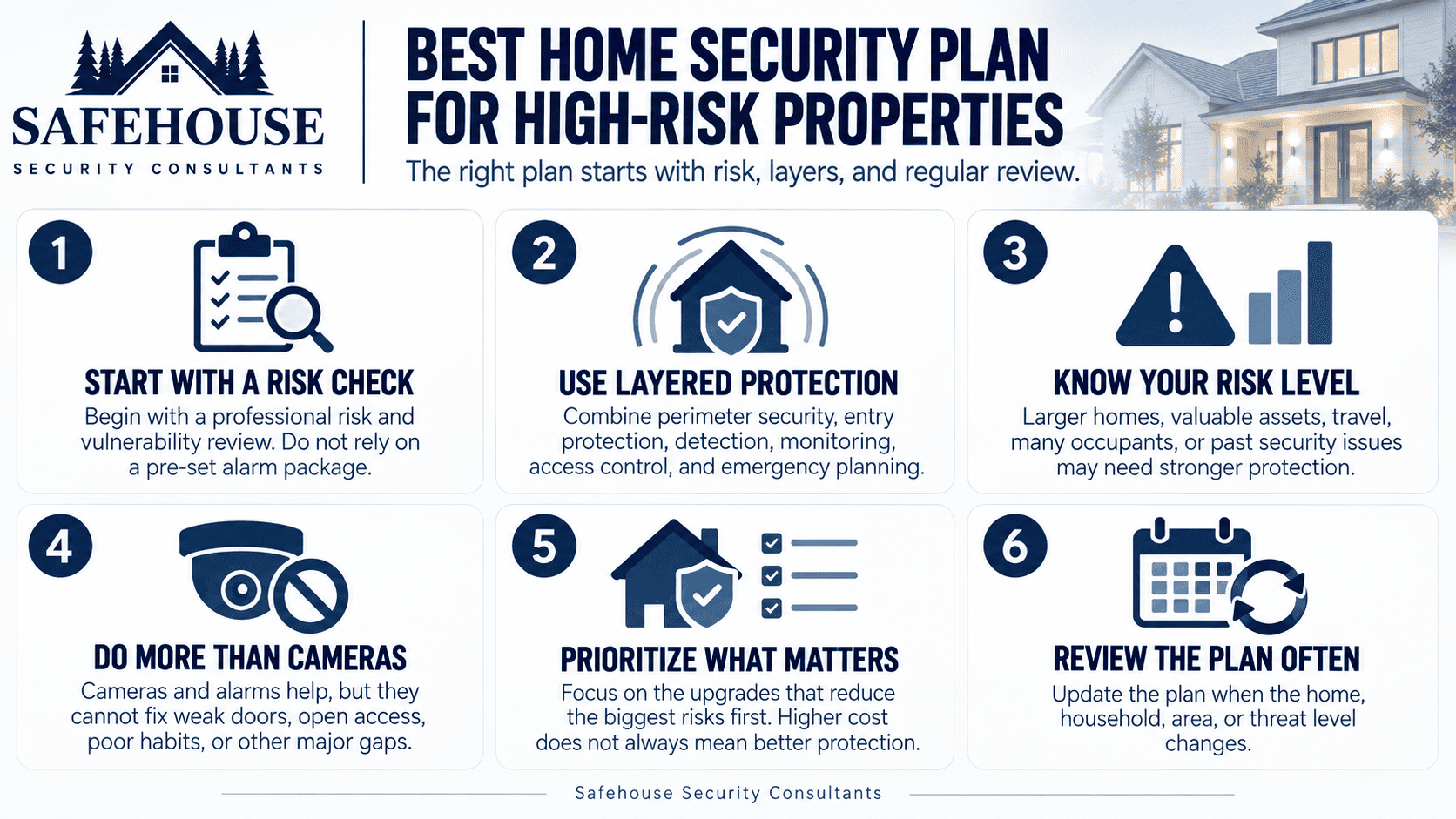
- The best Home Security Plan for a high-risk property starts with a professional risk and vulnerability assessment, not a prepackaged alarm system.
- Effective protection should be layered so that perimeter security, entry protection, detection, monitoring, access management, and emergency planning support one another.
- High-risk properties may need stronger controls because of property size, valuable assets, public exposure, frequent travel, multiple occupants, or previous security concerns.
- Cameras and alarms are useful components, but they cannot compensate for weak doors, uncontrolled access, poor procedures, or major gaps elsewhere in the property.
- Security improvements should be prioritized according to risk. The most expensive upgrade is not automatically the one that reduces the most meaningful vulnerability.
- A security plan should be reviewed as the property, household, surrounding area, or threat profile changes.
Book a Consultation Now
What Is the Best Home Security Plan for a High-Risk Property?
The best plan is an assessment-based, layered security plan in which several protective measures work together instead of relying on one device or system.
The Cybersecurity and Infrastructure Security Agency uses a similar security-in-depth concept in its physical-security guidance. CISA recommends evaluating vulnerabilities and combining measures across different layers instead of depending on one control to address every threat. It also recommends tailoring security measures to the property’s particular risks and needs.
For a residence, that generally means considering several areas together:
| Security Layer | Main Question |
| Property and perimeter | Can suspicious activity be identified before it reaches the home? |
| Exterior of the home | Are doors, windows, garages, gates, and other access points adequately protected? |
| Detection and surveillance | Can unusual activity or unauthorized entry be detected and verified? |
| Access management | Do the right people have access to the right areas at the right times? |
| Interior protection | Are people, important rooms, and valuable assets appropriately protected? |
| Monitoring and response | What happens when the system detects a genuine security event? |
| Household procedures | Does everyone know what to do when something unusual occurs? |
| Maintenance | Are systems tested, updated, and adjusted as conditions change? |
You may not need the maximum level of protection in every category.
The job of a good security assessment is to determine where additional protection actually makes sense.
What Makes a Property “High Risk”?
A high-risk property is one where the likelihood or potential consequences of a security incident justify more deliberate protection than a basic residential security package provides.
High risk does not necessarily mean high net worth.
Factors that can increase the need for a more comprehensive plan include:
- A large or complex property
- Multiple buildings or access points
- High-value personal or business assets
- A homeowner or family member with significant public exposure
- Previous burglaries, threats, stalking, or other documented security incidents
- Frequent travel or extended periods when the property is vacant
- Regular access by household employees, contractors, caregivers, vendors, or service providers
- Privacy concerns
- Location-specific crime patterns
- Older security infrastructure that has been expanded piecemeal over time
Several of these factors can exist at once.
That is when buying more cameras without first understanding the overall security problem can become expensive without necessarily making the property meaningfully safer.
Start With a Professional Security Assessment
A professional assessment should come before major equipment purchases because it establishes what you are protecting, what could realistically go wrong, where your current security is weakest, and which improvements deserve priority.
CISA treats security assessment as a foundational part of building an effective security program. Its Security Assessment at First Entry program, for example, uses a structured review of existing measures to identify vulnerabilities and provide options for improvement.
We follow the same assessment-first principle for residential properties.
At SafeHouse, our process begins with a consultation followed by an 80+ point assessment of the property, neighborhood, and surrounding area. We provide a detailed report with tailored recommendations rather than simply walking the property and trying to sell whatever equipment happens to be in a catalog.
Our in-person assessments typically take about two hours, and finished reports are provided within 48 hours.
That report becomes the blueprint for the Home Security Plan.
Layer 1: Protect the Property Before Someone Reaches the House
For high-risk properties, security should start beyond the front door.
The goal of perimeter protection is not to turn a home into a fortress. It is to improve visibility, control how people approach the property, identify unusual activity earlier, and create additional time to respond if a security problem develops.
Depending on the property, a professional may evaluate:
- Exterior lighting
- Gates and fencing
- Landscaping that affects visibility
- Driveways and vehicle access
- Pedestrian entrances
- Outdoor surveillance coverage
- Detached buildings
- Intercom or visitor-management systems
CISA’s physical-security guidance similarly encourages an outside-in approach in which outer, middle, and inner areas work together instead of being treated as separate systems.
A large estate may require much more attention at this layer than a townhouse or condominium.
That is why property-specific planning matters.
Layer 2: Strengthen Doors, Windows, and Other Entry Points
Alarm sensors tell you when an entry point has been disturbed.
Physical security affects how difficult that entry point is to compromise in the first place.
A comprehensive assessment should therefore examine the condition and security of exterior doors, locks, frames, windows, sliding doors, garages, and other legitimate access points.
The right improvement depends on the weakness.
Replacing an alarm panel will not fix a poorly secured door. Likewise, adding another camera may have limited value if a more basic physical-security issue remains unresolved.
For high-risk properties, the strongest plan usually combines intrusion detection with appropriate physical protection rather than assuming electronics alone will solve the problem.
Layer 3: Use Surveillance to Support Detection, Verification, and Response
Security cameras are most useful when they are part of a deliberate coverage plan.
The objective is not simply to own a large number of cameras.
A professional assessment should determine what areas require observation, what information needs to be captured, how footage is accessed, how alerts are handled, and how the camera system works with the rest of the security plan.
Depending on the property and risk level, the plan may consider:
- Outdoor surveillance
- Door and driveway monitoring
- Coverage of important access areas
- Low-light performance
- Motion or analytic alerts
- Remote viewing
- Recording and storage requirements
- Integration with monitored security systems
Privacy matters here too.
A high-risk property may contain family members, guests, employees, household staff, and sensitive personal information. Camera and account access should therefore be controlled rather than broadly shared simply because remote viewing is convenient.
Layer 4: Control Who Can Access the Property
Access control becomes increasingly important as the number of legitimate users grows.
A family may need access all day. A housekeeper may need access only during scheduled hours. A contractor may need temporary access to one part of the property. Former employees or vendors may no longer need any access at all.
The Home Security Plan should make those differences manageable.
Depending on the property, that may mean evaluating:
- Keys and lock management
- Smart locks
- Gates
- Entry codes
- Temporary access credentials
- Household employee access
- Service-provider access
- Visitor procedures
- Records of who can enter restricted areas
The goal is not simply stronger locks.
It is knowing who has access, where they have access, and whether that access still makes sense.
For households with many employees or service providers, that administrative side of security can be as important as the equipment itself.
Layer 5: Protect Important Interior Areas and Assets
A high-risk Home Security Plan should assume that perimeter protection may someday fail.
Layered security works because another safeguard remains in place when one layer is bypassed, damaged, or unavailable.
Inside the property, security planning may therefore consider additional protection for areas containing valuables, confidential documents, important technology, collections, or other sensitive assets.
The exact solution depends heavily on the property.
This is also where an assessment helps prevent overspending. Not every room requires the same level of security, and treating the entire house as equally sensitive can drive up cost without meaningfully improving protection.
Resources should follow risk.
Layer 6: Build Monitoring Around What Happens After an Alert
A security system is only part of a response.
A high-risk property should also have a clear answer to this question:
What happens after something is detected?
That may include professional alarm monitoring, camera verification, alerts to designated household members, coordination with security personnel where appropriate, and clearly defined procedures for unusual events.
Response planning also needs to account for false alarms.
A system that produces constant unnecessary alerts can train people to ignore notifications that eventually matter.
Monitoring should therefore be designed for useful information and clear escalation—not simply the maximum possible number of alerts.
Layer 7: Do Not Ignore the People Using the System
Technology can fail if nobody understands how the security plan is supposed to work.
A high-risk household may include family members, employees, guests, caregivers, and contractors. Each person does not need access to every security detail, but the people who use the property regularly should understand the procedures relevant to them.
That can include:
- How visitors are handled
- Who is permitted to provide access to vendors
- How security concerns are reported
- Who should receive system alerts
- What to do if an alarm activates
- How temporary access is issued and removed
- Who is responsible for updating the security provider when household circumstances change
A sophisticated security system paired with inconsistent procedures creates unnecessary gaps.
People and technology should support the same plan.
Should a High-Risk Property Have a Safe Room?
Some higher-risk situations may justify a protected interior location, but a safe room should not automatically appear on every homeowner’s shopping list.
Whether one is appropriate depends on the property’s threat profile, occupants, construction, emergency procedures, and other security measures.
It should be evaluated as part of the broader security plan rather than treated as a stand-alone product.
For many properties, fixing more basic vulnerabilities first may provide a greater practical improvement.
This principle applies throughout home security: prioritize the weakness with the greatest meaningful risk, not the feature that sounds most advanced.
What About Backup Communications and Power?
High-risk properties should consider what happens when ordinary systems are unavailable.
That does not mean every home needs a complicated redundant infrastructure.
It does mean a professional assessment should determine whether important security functions depend too heavily on one communications method, one power source, or one device.
The appropriate level of redundancy will vary according to risk.
A homeowner who frequently travels, for example, may place greater importance on reliable remote alerts and monitoring than someone who is almost always at the property.
Again, context changes the recommendation.
The Best Security Technology Is Not Always the Most Expensive
A higher price does not automatically mean a larger reduction in risk.
One property might benefit most from upgrading an aging alarm and surveillance system.
Another may already own excellent cameras but have problems with physical entry protection.
A third might have strong hardware but poor control over who still knows old codes or possesses keys.
The only sensible way to prioritize those situations is to look at the property as a system.
That is one reason we remain focused on assessment and strategy rather than starting with a particular manufacturer’s equipment.
SafeHouse states that we do not install the security hardware ourselves. Instead, we provide independent recommendations and can coordinate vetted vendors and negotiate implementation pricing on the client’s behalf.
That keeps the assessment focused on what the property needs.
How Should You Prioritize Security Upgrades if You Cannot Do Everything at Once?
Start with the vulnerabilities that combine meaningful likelihood with serious consequences, then build the remaining layers in phases.
CISA’s security guidance recognizes that layered improvements can be expensive and that security measures may need to be prioritized and implemented progressively.
A practical order may be:
- Correct serious vulnerabilities discovered during the assessment.
- Make sure primary access points and basic intrusion detection are dependable.
- Improve visibility and monitoring around priority areas.
- Address access management for employees, vendors, and other regular visitors.
- Add protection for important interior areas and assets where justified.
- Improve resilience, response procedures, and secondary protections based on the remaining risk.
That sequence is not universal.
Your assessment may reveal a different priority.
A good Home Security Plan explains not only what should be upgraded but also why one improvement should come before another.
Why an Off-the-Shelf Security Package Can Fall Short
Standard packages are designed to fit large numbers of households.
That is useful for ordinary residential needs.
High-risk properties are different because the variables quickly multiply.
Property size, architecture, household routines, surrounding terrain, staff access, privacy requirements, travel patterns, existing infrastructure, and documented threats can all affect the correct design.
The competitor content in this space commonly focuses on adding more sophisticated equipment to high-value homes. Professional-grade alarms, surveillance, access control, monitoring, and smart integrations can certainly play important roles.
But equipment should follow the assessment.
Otherwise, it is possible to build an expensive system around the wrong priorities.
How Often Should You Review a Home Security Plan?
A security plan should be reviewed whenever meaningful conditions change and periodically even when they do not.
Reasons to reassess may include:
- Moving into a new property
- Renovating or expanding the home
- Adding household employees
- Changing service providers
- Significant changes in travel patterns
- Purchasing or relocating valuable assets
- Changes in the surrounding area
- A security incident or credible concern
- Major changes to the alarm, surveillance, networking, or access-control systems
Security is not a one-time installation.
The property changes. Technology changes. Household routines change. The plan should be able to change with them.
Why Start With SafeHouse Security Consultants?
At SafeHouse, we believe a homeowner should understand the problem before being sold the solution.
Our security assessments review more than 80 points and include local crime-data analysis, a detailed report, and recommendations tailored to the home or business. We also help manage the implementation process so clients are not left trying to coordinate multiple security vendors themselves.
SafeHouse currently reports more than 22 years of professional security experience, 1,500+ clients protected, and relationships with 10+ vetted security vendor partners.
We serve homeowners throughout greater Los Angeles County, Orange County, and surrounding areas, with residential, commercial, and virtual assessment options available.
The goal is straightforward: identify the vulnerabilities that matter, build a practical plan around them, and help get the recommended improvements implemented.
Book a Consultation Now
Build the Security Plan Around Your Actual Risk
The best security plan for a high-risk property cannot be chosen from a package comparison alone.
You first need to know where the property is vulnerable, what risks matter most, how the existing security measures work together, and which improvements will make the greatest difference.
That is what our assessment process is designed to determine.
At SafeHouse Security Consultants, we evaluate the property, analyze the surrounding area, provide a detailed security plan, and help coordinate the recommended improvements so you do not have to manage the process alone.
Contact SafeHouse Security Consultants at (424) 352-8639 to schedule a consultation and start building a Home Security Plan around your property, your household, and your actual security needs.
Frequently Asked Questions
What should a high-risk Home Security Plan include?
A high-risk Home Security Plan should generally address the property’s perimeter, physical entry points, intrusion detection, surveillance, access management, monitoring, interior protection, emergency procedures, and ongoing system maintenance. The level of protection in each area should be based on a professional assessment rather than a generic checklist.
Is a monitored alarm enough for a high-risk property?
Usually not by itself. Monitoring can be an important layer, but high-risk properties often require attention to physical vulnerabilities, surveillance, access control, household procedures, and response planning as well. A layered approach reduces dependence on any single security measure.
Do high-risk homes need more cameras?
Not necessarily. The correct number and type of cameras depend on property layout, existing coverage, objectives, privacy considerations, and other security measures. Better planning can be more important than simply adding more devices.
Is professional security better than a DIY system?
DIY technology can be appropriate for some properties, but a high-risk property benefits from professional assessment because security decisions depend on interacting vulnerabilities rather than individual devices. The assessment can also determine where existing equipment is already adequate so money is not spent replacing something that works.
How much does a professional home security assessment cost?
Pricing varies according to the property and scope of work. SafeHouse provides a free consultation before the assessment so we can understand the property and discuss pricing. Hardware and installation are separate from the assessment fee.
How long does a SafeHouse security assessment take?
SafeHouse states that its physical assessments typically take about two hours and that completed reports are provided within 48 hours.
Does SafeHouse install security systems?
We do not install the hardware ourselves. Our role is to assess the property, recommend the appropriate improvements, help vet and coordinate the vendors who perform the work, and assist with implementation.