

A good Home Security Advisor should assess your property before recommending equipment.
That sounds obvious, but home security often gets approached in reverse. Homeowners start with cameras, alarm packages, sensors, smart locks, or monitoring plans and then try to determine where all that equipment belongs.
A better process begins with your home.
Where are the realistic entry points? Which doors and windows already have adequate protection? Does landscaping create concealment? Is exterior lighting helping or leaving blind areas? How useful are your existing cameras? Does your neighborhood’s crime pattern suggest particular concerns? And what changes would meaningfully reduce risk without making your home harder to live in?
At SafeHouse Security Consultants, our assessments are built around those questions. We conduct an 80+ point review of the property, analyze crime data for the surrounding area, provide a detailed report with tailored recommendations, and help manage implementation when changes are needed. Our assessment fee does not include security products, hardware, or installation; those are separate decisions based on the recommendations.
The goal is not to fill your house with equipment. It is to understand what actually needs improvement.
Key Takeaways
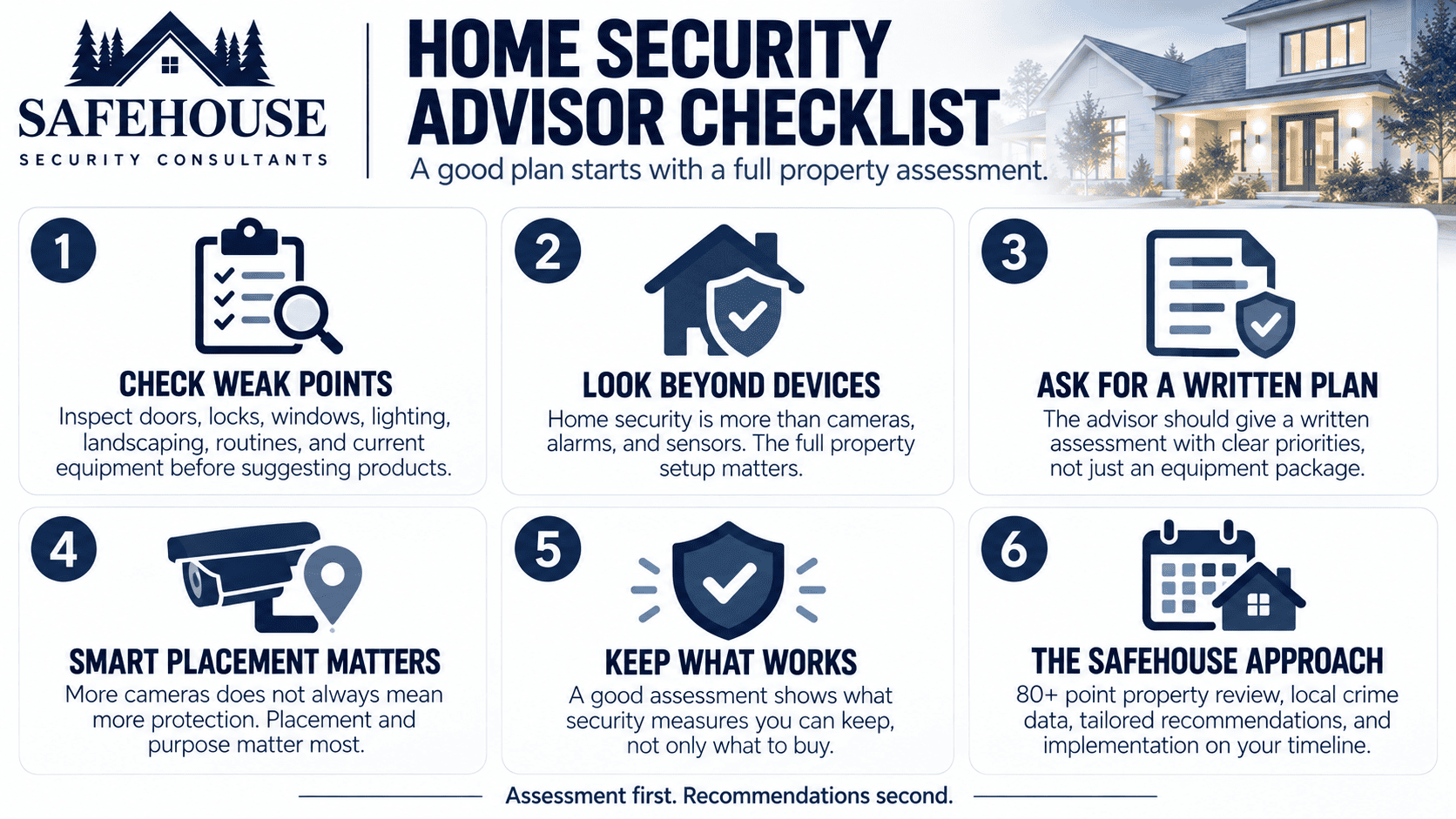
- A Home Security Advisor should inspect vulnerabilities before recommending cameras, alarms, sensors, or other products.
- Security is broader than electronics. Doors, locks, windows, lighting, landscaping, visibility, routines, and existing equipment can all affect the plan.
- Ask whether the advisor provides a written assessment that prioritizes recommendations instead of simply presenting an equipment package.
- More cameras and sensors do not automatically mean more protection; placement and the problem each device solves matter.
- A good assessment should identify security measures you can keep, not just things you need to buy.
- SafeHouse conducts an 80+ point property assessment, analyzes local crime data, provides tailored recommendations, and can coordinate implementation on the homeowner’s timeline.
Book a Consultation Now
What Does a Home Security Advisor Do?
A Home Security Advisor evaluates how well your property is protected, identifies vulnerabilities, and recommends practical ways to reduce those risks.
Equipment may be part of the answer, but it should not automatically be the starting point.
A thorough residential assessment can look at areas such as:
- Exterior doors and door frames
- Ground-level and accessible windows
- Sliding doors
- Garages and side entrances
- Gates and fences
- Landscaping and concealment
- Exterior lighting
- Camera positioning
- Alarm coverage
- Existing locks and hardware
- Visibility from the street or neighboring properties
- Household routines and access patterns
This assessment-first approach is consistent with broader physical-security practice. CISA’s physical security assessment model, although designed for facilities rather than private homes, begins by documenting existing good practices and vulnerabilities before identifying potential mitigation options. The property owner then decides which improvements fit the situation and operating constraints.
That is the right order.
Assess first. Prioritize second. Buy third—if buying anything is actually necessary.
Why Starting With a Security-System Package Can Lead to Unnecessary Equipment
A prebuilt security package solves a product-selection problem.
It does not necessarily solve your security problem.
Two homes of the same size can have very different needs.
One may have a visible front entrance, reinforced doors, limited ground-floor windows, strong lighting, and an existing camera covering the driveway.
Another may have:
- A hidden side gate
- An attached garage
- Large rear windows
- Poor lighting
- Dense landscaping around an entrance
- Multiple sliding glass doors
- Existing cameras pointed in ineffective directions
Giving both homeowners the same number of sensors and cameras because they own similarly sized houses misses the point.
Security decisions should connect a specific vulnerability to a specific response.
Sometimes that response is an electronic device.
Sometimes it is a lock, repair, lighting change, landscaping adjustment, or better use of equipment you already own.
Police crime-prevention guidance reflects this layered approach. Seattle Police, for example, recommends measures ranging from reinforced doors and strike plates to window security, visibility around landscaping, lighting, and properly directed motion lighting.
A security system is one layer. It is not the whole plan.
How Do You Choose a Home Security Advisor?
Choose a Home Security Advisor based on the quality of the assessment process, experience, recommendations, transparency, and ability to explain why each improvement is being suggested.
Before booking an assessment, ask what you will actually receive.
A useful consultation should leave you knowing:
- Where your most important vulnerabilities are.
- Which current security measures are already working.
- Which problems deserve attention first.
- What equipment, repair, or behavioral change addresses each problem.
- Which improvements can wait.
- What you do not need to spend money on.
A long shopping list is not necessarily evidence of a thorough assessment.
A prioritized plan is more useful.
Look for an Assessment Before the Product Recommendation
The advisor should be willing to understand the property before telling you exactly what to purchase.
At SafeHouse, our process starts with an initial consultation, followed by an assessment of the property, neighborhood, and surrounding area. The homeowner then receives reports and tailored security recommendations before implementation begins. Physical assessments typically take about two hours, with finished reports provided within 48 hours.
That order matters because recommendations should be based on what was found.
Be cautious when the conclusion seems predetermined before anyone has examined:
- Your entry points
- Existing locks
- Camera sight lines
- Lighting
- Property layout
- Neighborhood conditions
- Current alarm equipment
- Family routines
- Your actual concerns
If every homeowner receives essentially the same recommendation, it is worth asking how much of the property was really being evaluated.
Ask Whether You Receive a Written, Prioritized Report
A written security report gives you something more useful than a verbal list of products: a plan you can review and implement in stages.
The report should connect recommendations to observed vulnerabilities.
For example, “buy another camera” is vague.
A stronger recommendation explains what the additional camera is meant to accomplish:
- Cover an entrance that currently has no visibility
- Eliminate a blind area
- Improve identification at a specific approach
- Provide useful coverage of a driveway or gate
Likewise, “upgrade your windows” is not very actionable without understanding which windows are vulnerable and why.
SafeHouse’s 80+ point assessments include detailed reports with recommendations tailored to the property as well as crime-data analysis for the specific area.
Written findings also make it easier to prioritize your budget instead of buying everything at once.
Ask How Recommendations Are Prioritized
Not every security improvement deserves the same urgency.
A useful Home Security Advisor should be able to distinguish between:
- High-priority vulnerabilities: Problems that leave an important access point inadequately protected.
- Useful improvements: Changes that meaningfully strengthen security but may not require immediate action.
- Optional enhancements: Features that may improve convenience, awareness, or redundancy but are not fixing a major weakness.
That distinction can save homeowners from treating every recommendation as an emergency purchase.
It also gives you a roadmap.
If you have a limited budget today, you can address the most consequential weaknesses first and handle lower-priority improvements later.
Ask About Vendor Relationships and How Equipment Is Selected
A security consultant may work with equipment vendors, installers, repair professionals, or other specialists. That is not inherently a problem.
You should simply understand the relationship.
Ask questions such as:
- Does the advisor sell the equipment directly?
- Is the assessment fee separate from hardware and installation?
- Are several equipment options considered?
- Does the advisor receive compensation from recommended vendors?
- Can you choose a different installer?
- Can the advisor explain why one system or device suits your property better than another?
- Are recommendations based on the assessment or on a standard package?
SafeHouse currently works with more than 10 vetted security vendor partners and offers clients access to discounts for systems, repairs, or upgrades. The assessment price itself does not include products, hardware, or installation, and SafeHouse says it negotiates pricing on the client’s behalf when implementation is needed.
Knowing how that process works helps you distinguish the security recommendation from the purchase decision.
Ask Whether the Advisor Evaluates What You Already Own
This is one of the easiest ways to avoid unnecessary purchases.
A homeowner may already have:
- Cameras
- A video doorbell
- Door and window contacts
- Motion detectors
- Exterior lighting
- Deadbolts
- Smart locks
- An alarm panel
The question is not simply whether those devices are old or new.
The question is whether they are accomplishing what they need to accomplish.
A camera with a poor field of view may need repositioning rather than replacement.
An existing alarm system may have adequate coverage.
A door may need stronger physical reinforcement rather than another electronic sensor.
An assessment should look for ways to use existing security effectively before adding more hardware.
Do You Really Need Cameras Everywhere?
Usually, camera quantity should follow coverage needs—not the assumption that every part of a house needs video surveillance.
More cameras create more footage, more notifications, more equipment to maintain, and potentially more privacy concerns.
A Home Security Advisor should ask what each proposed camera needs to see.
Important variables include:
- Approaches to the property
- Exterior entrances
- Gates
- Driveway or garage access
- Blind areas
- Camera height
- Lighting conditions
- Field of view
- Whether existing cameras overlap
Installing three cameras that show essentially the same area is not necessarily better than one camera positioned correctly.
Interior cameras deserve additional thought because households differ considerably in their comfort with indoor recording.
A family that wants visual coverage while traveling may make a different choice from a family that prioritizes privacy inside the home.
There is no universal camera count that fits every property.
Do You Need Sensors on Every Window?
Not every window presents the same access risk, so sensor placement should be based on accessibility and vulnerability rather than window count alone.
Ground-level windows, secluded windows, basement openings, and windows that can be reached easily may deserve more attention than difficult-to-access upper-story windows.
Seattle Police specifically identifies ground-level, garage, basement, secluded, and otherwise easily accessible windows as higher-risk areas that warrant stronger physical security.
That does not mean upper windows should always be ignored. Property design can change accessibility.
A nearby roof, balcony, wall, tree, slope, or architectural feature may make an apparently elevated window easier to reach.
That is why walking the property matters.
Counting windows from an equipment catalog does not tell the whole story.
Do You Need Glass-Break Sensors?
Glass-break sensors can be useful in specific situations, but they should solve an identified coverage problem rather than be added automatically to every room.
Factors that may affect the decision include:
- Large accessible glass areas
- Sliding doors
- Window configuration
- Existing contact sensors
- Motion-detector coverage
- Alarm-system design
- How someone would realistically enter the area
Sometimes another part of the existing system already provides useful detection.
Sometimes the window itself deserves physical reinforcement.
The advisor should be able to explain the role a glass-break sensor would play in the overall security plan.
If the explanation is simply “more protection,” ask for more detail.
Do You Need Several Motion Detectors?
The answer depends on the layout.
Motion detection can provide useful interior coverage, but more sensors are not automatically better.
Placement may be affected by:
- Hallways and traffic routes
- Open floor plans
- Room arrangement
- Pets
- Interior doors
- Existing entry sensors
- How the property is occupied
A well-placed detector that covers a likely movement path may be more useful than several poorly positioned devices.
The purpose of the assessment is to figure out where detection adds something that is currently missing.
Physical Security Can Matter More Than Another Electronic Device
A camera can record someone approaching a weak door.
It does not make the weak door stronger.
That is why a good residential security assessment should consider physical protection alongside detection technology.
Police guidance commonly includes measures such as reinforced doors, substantial strike plates, secure hinges, protected sliding doors and windows, appropriate locks, lighting, and clear visibility around access points. Seattle Police specifically recommends solid or reinforced exterior doors, heavy-duty strike plates, long screws, secure hinges, and additional protection for vulnerable windows.
Los Angeles Police Department crime-prevention guidance likewise stresses effective lighting, reducing shadows and blind areas, protecting hinges, and securing windows and other potential access points.
Sometimes the next dollar is better spent strengthening a vulnerable entry than adding another smart device.
Landscaping and Lighting Belong in a Security Assessment Too
Some security improvements do not involve an alarm system at all.
Shrubs, walls, fences, and other landscaping can affect visibility around doors and windows.
Lighting can either expose an approach or leave shadows that provide concealment.
Seattle Police advises maintaining visibility around the home’s perimeter and directing motion lighting toward entry points and vulnerable areas.
LAPD guidance similarly recommends placing lighting to reduce blind spots and shadows rather than simply flooding an area indiscriminately.
These details are easy to miss when home security begins with an online equipment bundle.
An advisor walking the property can see them.
Local Crime Data Should Inform the Assessment—Not Frighten You Into Buying More
Crime data is useful when it helps identify relevant patterns and priorities. It should not be used as a scare tactic.
A neighborhood with one type of recurring property crime may warrant different attention from another area with a different pattern.
Useful analysis might help answer:
- What types of property crime are occurring nearby?
- Are certain access methods or locations relevant?
- Are incidents concentrated at particular times?
- Does your property share characteristics that deserve attention?
SafeHouse includes crime-data analysis for the client’s specific area as part of its 80+ point security assessment.
The data is one input.
It should be considered alongside the design of the property, existing security, household habits, and homeowner priorities.
No crime statistic can tell you by itself how many cameras to buy.
Red Flags When Choosing a Home Security Advisor
A security consultation should leave you more informed, not simply more anxious.
Watch for warning signs such as:
- Recommending a package before inspecting the property
- Treating every window or room identically
- Refusing to explain why specific equipment is needed
- Ignoring existing equipment that may still be useful
- Using fear as the primary sales argument
- Treating every recommendation as equally urgent
- Focusing entirely on electronics while ignoring doors, lighting, sight lines, or physical vulnerabilities
- Providing no written explanation of findings
- Being unclear about equipment pricing or vendor relationships
One of the simplest tests is to ask:
“What do I already have that you would keep?”
A real assessment should be able to answer that question.
What Should a Home Security Assessment Include?
At SafeHouse, we believe the assessment should give you enough information to make security decisions in the right order.
Our process includes an 80+ point assessment covering the property, neighborhood, and surrounding area. We provide:
- A detailed security report
- Tailored recommendations
- Crime-data analysis for your specific area
- An implementation plan
- Help coordinating recommended improvements
- Access to negotiated discounts through vetted security vendor partners when equipment, repairs, or upgrades are needed
Our physical assessments generally take about two hours, and finished reports are provided within 48 hours. We continue working with clients as they implement recommendations on their own timeline.
We also offer virtual assessments for homeowners who need another way to complete the process.
A Better Way to Think About Your Security Budget
Instead of asking, “How much should I spend on a home security system?” start with:
“Which vulnerabilities should I fix first?”
Those are very different questions.
Suppose you have $2,000 available.
Without an assessment, that might become a large package of cameras, sensors, and smart-home equipment.
After an assessment, you might discover that your priorities are actually:
- Reinforcing a vulnerable exterior door.
- Improving visibility near a side entrance.
- Correcting one major camera blind spot.
- Adding detection to an accessible rear opening.
- Keeping several existing devices exactly as they are.
The second approach may use less equipment while addressing more meaningful problems.
That is the value of planning before purchasing.
Who Benefits Most From Working With a Home Security Advisor?
A professional assessment can be especially useful when you are unsure what your property needs rather than simply replacing a known device.
That may include:
Homeowners Moving Into a New Property
A new home means unfamiliar doors, sight lines, neighborhood patterns, existing equipment, and previous modifications.
An assessment establishes a baseline before you begin buying upgrades.
Homeowners With an Existing Security System
Older does not automatically mean inadequate.
An advisor can look at what still works, identify gaps, and determine whether optimization or selective upgrades make more sense than starting over.
Families After a Nearby Security Incident
A burglary or other incident in the neighborhood can understandably cause people to rethink security.
The goal should be to respond deliberately rather than buy everything available while emotions are high.
People Buying or Selling a Home
SafeHouse also works with buyers and sellers. A security assessment can help buyers understand vulnerabilities before or after a purchase and give sellers a documented review of the property’s security measures.
Homeowners Who Want Someone Else to Handle Implementation
Knowing what needs to change and managing installers, repairs, vendors, and upgrades are different jobs.
SafeHouse’s process can continue into implementation, coordinating the logistics of recommended improvements instead of leaving the homeowner with a report and a long list of vendors to contact.
Questions to Ask Before Hiring a Home Security Advisor
Before choosing an advisor, ask questions that reveal how the process works rather than simply asking which alarm brand they prefer.
What does the assessment cover?
You should understand whether the review includes physical security, lighting, property layout, existing electronics, neighborhood conditions, and other relevant areas.
Will I receive a written report?
A report lets you review recommendations instead of making purchase decisions during the assessment.
Will recommendations be prioritized?
Find out what needs attention now and what can reasonably wait.
Do you evaluate equipment I already own?
A useful advisor should be willing to keep effective existing equipment.
How do you choose recommended vendors or products?
Understand any vendor relationships and how options are evaluated.
Are hardware and installation included in the assessment fee?
SafeHouse separates its assessment from products, hardware, and installation.
Can I implement changes in stages?
A good plan should work with your priorities and budget instead of requiring every recommendation at once.
Who coordinates the work if I decide to proceed?
Some consultants stop at the report. Others, including SafeHouse, can help with implementation logistics.
Book a Consultation Now

Home Security Should Be Designed Around the Home
There is nothing inherently wrong with a basic home-security kit.
For some homes, it may cover exactly what is needed.
The problem comes when the kit becomes the strategy.
A security plan should account for the individual property, the people living there, neighborhood conditions, access points, existing protection, and realistic vulnerabilities.
Then equipment can be selected with a reason behind each component.
At SafeHouse Security Consultants, our job begins with the assessment—not with telling you how many boxes to buy.
With more than 22 years of professional security experience, more than 1,500 clients protected, and a network of vetted security vendor partners, we help homeowners understand what needs attention, create a tailored plan, and coordinate improvements when they decide to move forward.
Contact SafeHouse Security Consultants at (424) 352-8639 to schedule a consultation and find out what your home actually needs before investing in more security equipment.
Frequently Asked Questions
What is a Home Security Advisor?
A Home Security Advisor evaluates a home’s security vulnerabilities and recommends ways to reduce risk. A thorough assessment can include doors, windows, locks, lighting, landscaping, alarm coverage, cameras, neighborhood conditions, and existing security measures rather than focusing only on equipment sales.
Is a home security assessment the same as getting a security-system quote?
No. A system quote primarily tells you what equipment and services a company proposes to sell. A security assessment should first identify vulnerabilities, existing strengths, and priorities. SafeHouse separates its assessment fee from products, hardware, and installation.
Do I need a camera on every side of my house?
Not necessarily. Camera placement should reflect access routes, blind areas, field of view, lighting, and existing coverage. Adding cameras without identifying what each one needs to see can create redundancy rather than meaningful additional protection.
Do all ground-floor windows need alarm sensors?
Accessible ground-floor windows deserve careful attention, but the appropriate solution can depend on window design, physical security, existing alarm coverage, and the home’s layout. A property assessment helps determine which openings present meaningful vulnerabilities.
Is a more expensive home security system always safer?
No. Security depends on how well the measures address actual vulnerabilities. Proper door hardware, better exterior lighting, useful camera placement, or targeted repairs may sometimes improve security more than adding additional electronic equipment.
Can a Home Security Advisor work with my existing alarm and cameras?
A good advisor should evaluate existing security equipment before recommending replacement. Some devices may work well as they are, while others may need repositioning, repair, reconfiguration, or selective upgrading.
Should I buy security equipment before the assessment?
If there is no immediate need to replace a failed device, it usually makes sense to complete the assessment first. That gives you a clearer idea of which improvements should receive your budget and helps reduce unnecessary purchases.
How long does a SafeHouse security assessment take?
SafeHouse says its physical assessments typically take about two hours, with finished reports delivered within 48 hours. The company also offers virtual security assessments.