

Upgrading home security in Los Angeles starts with understanding how someone could enter your property, where they could move without being seen, and whether your existing security system would still work if one layer failed.
That matters because a camera or alarm by itself does not secure a home. A stronger approach combines physical barriers, early detection, good lighting, reliable alarm communication, and a response plan.
Recent Los Angeles burglary cases also show why homeowners should think beyond the front door. In 2026, authorities reported residential burglary crews using tactics that included hidden surveillance cameras and Wi-Fi jammers, while other incidents involved forced entry through windows, doors, and sliding glass doors.
The right upgrades will depend on your property’s layout, neighborhood, access points, current equipment, and vulnerabilities. That is why we recommend starting with a security assessment instead of buying equipment first.
Key Takeaways
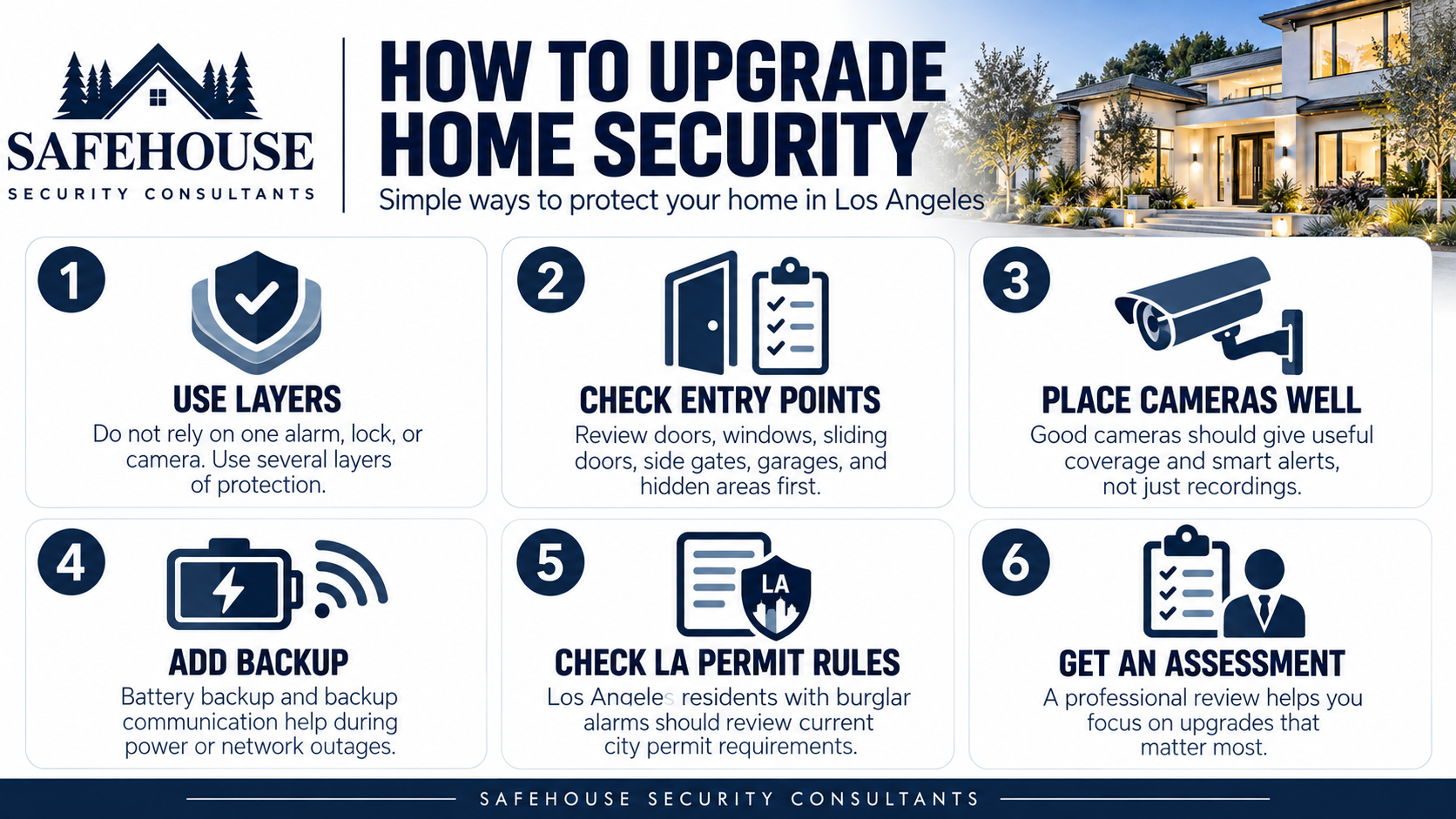
- The best way to upgrade home security is to use several layers rather than relying on a single alarm, lock, or camera.
- Doors, windows, sliding doors, side gates, garages, and less-visible areas should be evaluated before choosing new technology.
- Cameras work better when they provide useful coverage and alerts instead of simply recording activity after an intrusion.
- Battery backup and alternative alarm communication can reduce the risk of losing protection during an outage or network interruption.
- Los Angeles residents using burglar alarm systems should check current City of Los Angeles alarm-permit requirements.
- A professional assessment can help identify which upgrades deserve priority instead of spending money on equipment that does not address the home’s main weaknesses.
Book a Consultation Now
1. Start With a Residential Security Assessment
Before adding cameras or replacing an alarm panel, find out where your home is actually vulnerable.
A security assessment looks at the property as a complete system. An evaluator should consider how easily someone could approach the home, which doors and windows are easiest to attack, what areas are hidden from view, how the existing alarm works, and what happens if an intruder avoids or defeats one security measure.
Our 80+ point residential security assessment is designed to identify those gaps. The assessment includes a detailed report with recommendations tailored to the property and crime-data analysis for the surrounding area.
That distinction is important. Two Los Angeles homes on the same street can have very different security needs.
For example, one property may have a strong front entrance but an exposed rear sliding door. Another may have cameras everywhere but poor lighting along a side walkway. A hillside property could have access from an area that is difficult to see from the street. A home with mature landscaping may have hiding areas that did not exist when the security system was originally installed.
An assessment helps answer a more useful question than What security products should I buy?
It answers: Where can this particular home be improved first?
2. Reinforce Exterior Doors Before Adding More Technology
Exterior doors should be difficult to force open because they are one of the most direct routes into a home.
Start by looking at the entire door assembly rather than only the lock. A strong deadbolt cannot do its job properly if the frame, strike plate, hinges, or surrounding material fails under force.
The LAPD recommends quality deadbolt locks on exterior doors and emphasizes that the door frame needs to be strong as well.
Depending on the existing construction, useful upgrades may include:
- Reinforcing the strike plate and door jamb
- Using longer, appropriately sized fasteners that reach secure framing
- Replacing weak or damaged exterior doors
- Inspecting exposed hinges and hardware
- Upgrading locks that are worn, loose, or poorly installed
- Adding a wide-angle viewer where appropriate
- Checking whether decorative glass creates an additional vulnerability near the lock
The goal is not to make a home impossible to enter. No residential security measure can promise that.
The goal is to make forced entry more difficult, more noticeable, and more time-consuming while giving other security layers an opportunity to detect the attempt.
3. Secure Windows and Sliding Glass Doors
Windows and sliding doors deserve the same attention as the main entrance.
Recent Los Angeles burglary reports have included incidents involving smashed glass, pried windows, and entry through sliding doors.
For sliding glass doors, check whether the factory lock is the only thing preventing the door from opening. Depending on the door design, a secondary lock or properly fitted track restriction can add another barrier.
Windows should be checked for damaged locks, loose frames, and locations that allow someone to work out of sight.
Security film may also be considered for some glass areas. It can help hold broken glass together and make rapid entry through glazing more difficult, but homeowners should understand its limitations. Film does not make ordinary glass unbreakable, and performance depends heavily on the product and installation method.
Second-floor openings should not automatically be treated as safe either. Los Angeles authorities have reported burglars using ladders and targeting upper-level access points.
Look at anything around the property that could help someone climb, including stored ladders, walls, trees, patio structures, or equipment.
4. Eliminate Blind Spots Around the Property
Good exterior security gives you visibility before someone reaches a door or window.
Walk around the property after dark and look at it from the perspective of someone trying not to be seen.
Pay attention to:
- Side yards
- Rear entrances
- Gates
- Driveways
- Garage doors
- Areas behind walls or hedges
- Dark corners near windows
- Pathways leading from the street to the house
Lighting should improve visibility without creating deep shadows or excessive glare. The LAPD recommends exterior lighting and notes that fixtures should be placed to reduce blind spots and hiding places.
Landscaping matters, too. Overgrown shrubs around windows and entrances can create concealment. CISA recommends maintaining vegetation so it does not provide hiding places or obstruct visibility from inside the home.
Motion-activated lighting may be useful in some locations, while consistent dusk-to-dawn lighting can make more sense in others.
A security assessment can help determine where light improves security and where it simply creates more brightness without improving visibility.
5. Upgrade Cameras for Detection, Not Just Recording
A security camera is more useful when it tells you something is happening early enough to respond.
Older camera systems may record excellent footage but provide little warning before someone reaches the house. Modern systems can offer features such as motion zones, person detection, doorbell alerts, remote viewing, and notifications when activity occurs in selected areas.
The key is placement.
A camera pointed at the front porch may provide a clear image of visitors but do nothing for someone approaching from a rear alley or side gate.
Instead of asking how many cameras you need, consider:
What areas need to be seen, how early do you want activity detected, and what action should happen when an alert occurs?
Useful coverage may include the front approach, driveway, rear entry, vulnerable side access, garage, and other paths leading toward likely entry points.
Avoid unnecessary coverage of neighboring private areas, and configure activity zones carefully so constant street movement, trees, or passing cars do not create so many notifications that important alerts are ignored.
6. Protect Smart Security Equipment From Network Problems
Smart cameras, locks, and alarms introduce another issue: your home-security network needs protection too.
CISA recommends changing factory-default router credentials, securing Wi-Fi, and using multi-factor authentication where supported for connected devices.
For home security specifically, consider what happens if:
- Internet service goes down
- Power is interrupted
- The router stops working
- A wireless connection is disrupted
- Your phone is unavailable
- A device battery dies
This is where redundancy matters.
A security system that depends entirely on home internet may lose important functions if that connection disappears. Depending on the system, cellular communication and battery backup can provide another path for alarm signals and help maintain protection during certain outages.
The LAPD also identifies battery backup as an important alarm-system feature.
Ask your provider exactly which parts of the system continue working during a power or internet failure. Do not assume every component has backup simply because the main alarm panel does.
7. Decide Between Self-Monitoring and Professional Monitoring
Self-monitoring and professional monitoring solve different problems.
With self-monitoring, alerts usually go directly to you through an app. This can work well for homeowners who want direct control and are able to review notifications quickly.
The drawback is that you are responsible for noticing the alert and deciding what to do.
That can be difficult if you are asleep, flying, in a meeting, without cellular service, or simply away from your phone.
Professional monitoring adds a staffed response layer that can handle alarm events according to the monitoring service’s procedures. It typically involves ongoing fees, so it may not be necessary for every household.
The better choice depends on your risk level, lifestyle, budget, current equipment, and how much responsibility you want to keep for handling alerts.
For some households, a hybrid approach makes sense: smartphone access for everyday awareness combined with professional monitoring for alarm events.
8. Check Los Angeles Alarm Permit Requirements
If your property is within the City of Los Angeles and uses a burglar alarm system, make sure you understand the city’s alarm-permit rules.
The Los Angeles Office of Finance states that residential and commercial burglar alarm users must have a valid alarm permit. Its current information lists an initial permit fee of $60 and an annual renewal fee of $31, with updated false-alarm fees effective May 4, 2026.
Those requirements apply to the City of Los Angeles. If your mailing address says Los Angeles but the property is actually in another incorporated city or an unincorporated part of Los Angeles County, different requirements may apply.
Check the appropriate local authority before assuming the city’s rules cover your property.
False alarms also matter. Poor sensor placement, outdated equipment, unsecured doors, pets, user errors, and neglected maintenance can all contribute to nuisance activations.
A properly configured system should provide useful detection without creating alerts so often that residents stop taking them seriously.
9. Do Not Ignore the Garage, Gates, and Property Perimeter
Security often breaks down away from the main house.
A garage may contain tools, vehicles, stored valuables, keys, or another door leading directly into the living area. Side gates can provide hidden access to rear doors and windows. Exterior equipment may even give an intruder something to climb on.
Check that:
- Garage doors close and secure properly
- The door between an attached garage and the home has appropriate locking hardware
- Side gates cannot be opened easily from outside
- Ladders and useful climbing tools are secured
- Fences do not have obvious damaged sections
- Address numbers are easy for emergency responders to see
- Outdoor valuables are not clearly visible from public areas
Los Angeles police guidance has long emphasized securing garages and common access areas and making exterior security part of the overall plan rather than treating the front door as the only concern.
10. Build Security in Layers
The most practical way to think about home security is as a sequence.
A strong system attempts to discourage approach, expose suspicious activity, delay entry, detect intrusion, communicate the event, and support an appropriate response.
Different upgrades handle different parts of that sequence.
| Security Layer | Main Purpose | Examples |
| Perimeter awareness | Identify activity before someone reaches the house | Lighting, cameras, trimmed landscaping |
| Entry resistance | Make forced entry harder | Door reinforcement, deadbolts, window locks |
| Detection | Identify an attempted or completed intrusion | Door contacts, glass sensors, motion sensors |
| Communication | Send alerts when something happens | Internet, cellular backup, app alerts |
| Response | Make sure someone can act on the alert | Self-monitoring or professional monitoring |
| Backup | Keep critical functions operating during failures | Battery backup, redundant communication |
One weak layer does not necessarily defeat the entire system when the property has meaningful backup measures.
That is the real advantage of layered security.
Which Home Security Upgrades Should You Prioritize First?
Prioritize the weaknesses that create the easiest path into your particular home.
For one homeowner, that could mean replacing a weak rear door before purchasing another camera.
For another, the biggest problem may be a long, dark side yard that leads directly to an unprotected window.
Someone else may already have good physical security but an outdated alarm that depends completely on a single communication method.
A useful order is:
- Identify vulnerable access points.
- Correct basic door, window, gate, and lighting weaknesses.
- Improve detection around likely approaches.
- Confirm alarm coverage inside the home.
- Add communication and power backup where appropriate.
- Review how alerts are monitored and handled.
- Test the system regularly.
Do not assume the most expensive upgrade is automatically the most important one.
Why a Home Security Assessment Can Save You From Buying the Wrong Equipment
A security assessment helps separate genuine vulnerabilities from upgrades that simply look impressive.
Buying equipment first can create gaps. You might install another camera where coverage is already good while leaving an older sliding door poorly secured. You could replace an alarm panel without addressing the landscaping that blocks several camera views. Or you might add smart devices without knowing how those devices behave if the internet goes down.
Our 80+ point security assessment looks at the property before recommendations are made.
Each assessment includes:
- A detailed report with recommendations tailored to your home
- Crime-data analysis for your specific area
- Review of security weaknesses and upgrade priorities
- Help handling the logistics involved in implementing recommended security measures
- Access to available discounts on qualifying new security systems, repairs, or upgrades you may need
For homeowners who cannot schedule an on-site visit, we also offer a Virtual Security Assessment conducted through live video, designed to provide the same level of detail and value as our in-person service.
We also provide Commercial Security Assessments for businesses that want to protect their property, employees, and customers.
Common Home Security Upgrade Mistakes
More equipment does not automatically mean better security.
One common mistake is installing cameras everywhere while leaving doors and windows mechanically weak. Another is placing cameras too high or too far away to capture useful detail.
Other problems include ignoring second-floor access, failing to replace camera batteries, never testing an alarm’s backup power, using the same weak password across connected devices, or allowing landscaping to create new blind spots after the security system was installed.
There is also a more basic problem: security changes over time.
A remodel may add a new side door. Landscaping grows. A fence is replaced. Wi-Fi equipment changes. Family routines change. New smart devices are added.
A system that made sense several years ago may no longer match the property today.
Book a Consultation Now
Make Your Home a SafeHouse
You do not need to turn your property into a fortress to improve security. You need to understand where the weak points are and strengthen them in the right order.
Our Residential Security Assessment examines more than 80 points throughout your security setup and gives you a detailed plan based on your property and local crime information. If upgrades are recommended, we can also handle the time-consuming logistics of putting those measures in place.
The goal is simple: spend your security budget where it can make the most meaningful difference. Contact SafeHouse Security Consultants at (424) 352-8639
FAQs About Upgrading Home Security in Los Angeles
What is the best way to upgrade home security?
The best approach is layered security. Strengthen doors and windows, improve exterior visibility, install properly positioned detection equipment, make alarm communication more reliable, and establish a response plan. The right combination depends on the property’s actual vulnerabilities.
Should I upgrade my locks or cameras first?
Fix serious physical entry weaknesses first if a door or window can be forced open easily. Cameras can detect or document activity, but they do not physically stop entry. Ideally, physical reinforcement and detection should work together.
How many security cameras does a house need?
There is no useful one-size-fits-all number. Camera quantity should depend on the home’s layout, approach routes, entrances, blind spots, surrounding structures, and the field of view of each camera. Good placement matters more than simply increasing the camera count.
Is Wi-Fi enough for a home alarm system?
Wi-Fi can support many security devices, but relying on one communication method creates a potential single point of failure. Depending on your risk level and equipment, cellular communication and battery backup can add redundancy.
Do I need an alarm permit in Los Angeles?
If your property is within the City of Los Angeles and you operate a burglar alarm, the City requires an alarm permit. The Los Angeles Office of Finance currently lists a $60 initial permit fee and $31 annual renewal fee. Requirements and fees can change, so confirm them with the city before relying on these figures.
Can a virtual security assessment really evaluate my home?
A live-video assessment can be used to examine entrances, windows, exterior access, camera placement, lighting, alarm equipment, and other visible security conditions. Our Virtual Security Assessment is designed to provide the same level of detail and value as our in-person services while allowing the evaluation to be conducted remotely.